
Humidity sensor, your ally to combat water vapor in the air
The cold temperatures are approaching and with them the risk of contracting more illnesses. But it's not just the cold outdoors that can cause colds or pulmonary complications; we can also experience a risky situation inside our homes. Especially in old houses with poor air renewal, where winter humidity can become a serious problem. To control this issue, we have the humidity sensor used in measuring devices and air renewal systems, which we could say is the most practical way to know if we have an excess of water vapor in the air at home.
To measure the humidity at home, while there are homemade methods, the most practical and recommended is to use a device equipped with a humidity sensor, which will tell us the percentage of water vapor present in the environment. These sensors can be mounted in a homemade humidity meter or in mechanical ventilation systems to control when humidity should be eliminated. Those included in the meters are usually much simpler, and there are different types available. From the most common to the highly professional ones. They can be used both in homes or individual rooms as well as in large buildings.
 rnIn general terms, the humidity sensor is a reader that, in addition to the water vapor, usually calculates the temperature. The magnitudes measured are transformed into a normalized electrical signal, whose intensity generally ranges between 4 and 20 mA. And they are very precise in reading the amount of water vapor, which makes them essential for hygroregulated mechanical ventilation systems and dual flow systems.
What types of humidity sensors can we generally find in their operation?rn
- rn
- Mechanical sensors. They make use of the dimensional changes of some materials in contact with humidity, such as organic fibers. rn
- Hygroscopic salt sensors. They obtain the value of humidity in the environment thanks to a molecule with a great affinity for water. rn
- Conductivity sensors. Water is a conductor of electricity, so it passes through fine filaments that deduce the level of humidity. rn
- Capacitive sensors. They determine the humidity thanks to the change in capacity of a capacitor. rn
- Resistive sensors. They use a principle of soil conductivity. The more water present in the sample, the higher the conductivity of the soil. rn
- Infrared sensors. They absorb the radiation contained in the water vapor through two infrared sources. rn
The humidity sensor in measuring devices
rn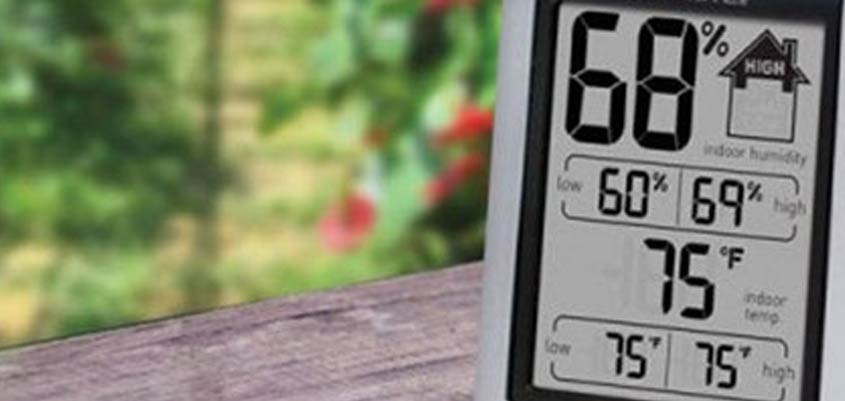
One of the most well-known mechanisms of the humidity sensor is its presence in humidity meters, the best allies in the home to detect if we have an excess of water vapor in the air. And also to correct these issues.
The recurrent problems that elevated humidity can cause in people are:rn
- rn
- Respiratory infections. rn
- Asthma problems. rn
- Allergies. rn
- A worsening of rheumatic diseases. rn
- Bone pain. rn
- Bad odors. rn
- Discomfort at home. rn
- Defects in the ceilings and walls of the rooms. rn
- Deterioration of furniture and other home furnishings. rn
The humidity in the environment should not exceed 55%, and it should not be below 25%. To control it, there are measuring devices that incorporate a humidity sensor to read the humidity. They are known as hygrometers and are usually:rn
- rn
- Analog hygrometers. They have a wheel like an analog clock where the humidity values are marked. They have a margin of error of 10%, but they are cheap and easy to use. rn
- Digital hygrometers. They can provide the values of relative humidity with an electrical sensor affected by humidity. They are more specific than analog ones, although they too have a margin of error of 5% either way. rn


Siber Ventilation
Related posts

Dehumidifiers and Other Systems to Improve the Health of Our Buildings

What should be the ideal humidity level at home?