Influence of controlled mechanical ventilation against radon gas
Radon is a radioactive gas that has a natural origin. It is common for it to accumulate in indoor spaces, such as homes, offices, or any other. It is considered the second leading cause of lung cancer, only behind tobacco. It is important to note that there is no safe level of radon exposure for health. However, the lower the exposure, the less likely one is to suffer from this serious disease. However, there are proven and long-lasting methods to prevent the gas from leaking into homes. Moreover, these can be applied both in newly constructed buildings and in those that are already built. One of them is controlled mechanical ventilation against radon gas.
What is radon and how does it act?
Radon is a natural gas that has no odor, color, or taste. It is a byproduct of the natural radioactive decay of uranium, a metal present in the subsoil and rocks of the granitic terrain of the Iberian Peninsula. Uranium is solid, but as it decomposes into radon, it changes to a gaseous state, emanates from the ground, and is now in the air, where it continues its life cycle. During this life cycle, radon progressively decays, emitting radioactive particles and generating other byproducts that may be in the form of microparticles that remain suspended in the air. These particles, when inhaled, can settle in the respiratory pathways. If this happens, they can damage DNA and cause the dreaded lung cancer. Outdoors, radon does not pose any problem, but in enclosed places, the aforementioned emanations from the subsoil can concentrate to levels that cause harm to humans. As we mentioned, the higher the concentration of radon, the greater the chances of suffering from lung cancer. Additionally, smokers have even more risk. The amount of radon in homes depends on the amount of uranium present in the land on which the building is constructed. The amount that seeps into homes also depends on several factors, such as the type of construction, its airtightness, and the way the house is ventilated. Radon enters the home through cracks in floors, the pores of concrete blocks, the spaces surrounding cables or pipes, or through drains, for example. The highest concentration occurs in rooms that are in direct contact with the structure, such as basements.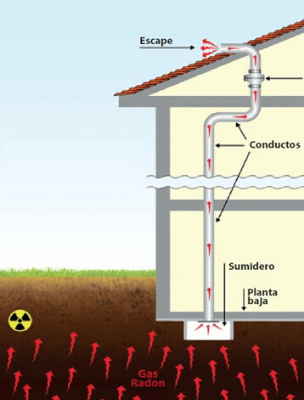
How does controlled mechanical ventilation influence radon gas?
When constructing a home, it is necessary to assess the exposure to radon gas that the building may experience. It is especially important to take this into account in areas with high concentrations of uranium. In the United States and in an increasing number of European Union countries, new buildings have measures that protect homes from this gas. In fact, in Spain, it is already mandatory to evaluate this health risk according to the new CTE, which is mandatory starting June 2020.How can radon concentration be reduced in already constructed homes? By implementing these measures:
- Installing a mechanical radon extraction system in the area of the building closest to the ground. This is usually the most economical and effective measure to prevent radon buildup in those areas closer to the ground.
- Improving the ventilation of the flooring.
- Preventing radon from seeping from the part of the home in contact with the ground to the rest of the rooms.
- Sealing the floors and walls.


Siber Ventilation
Manufacturer of High Energy Efficiency Ventilation Systems. Siber provides a set of high energy efficiency solutions in wind and mechanically intelligent ventilation, improving the Health, Hygiene, and Comfort of people, being respectful of the environment.
Related posts

Efficient rehabilitation
clean air
fan
extractor
inflate
exchanger
clean air
extractor
inflate
fan
exchanger
How to blow and how to extract air in indoor spaces
Discover how to blow using natural and mechanical air intake with mechanical extraction