The advantages of ventilated roofs
If there is a predominant element in roofs in Spanish houses, it is the roofs with ceramic tiles. We see them in countless cities and towns and with their sloped placement, they are part of the landscape. And while they have been around for centuries, they now incorporate a new measure of energy efficiency in the form of ventilation under the roof. This is known as ventilated roofs.
The Spanish tile, made with a clay base at high temperatures and currently flat-surfaced, has great acceptance worldwide. Normally, until now, they were mounted using paste to adhere them to the surface, which could cause moisture and poor ventilation.
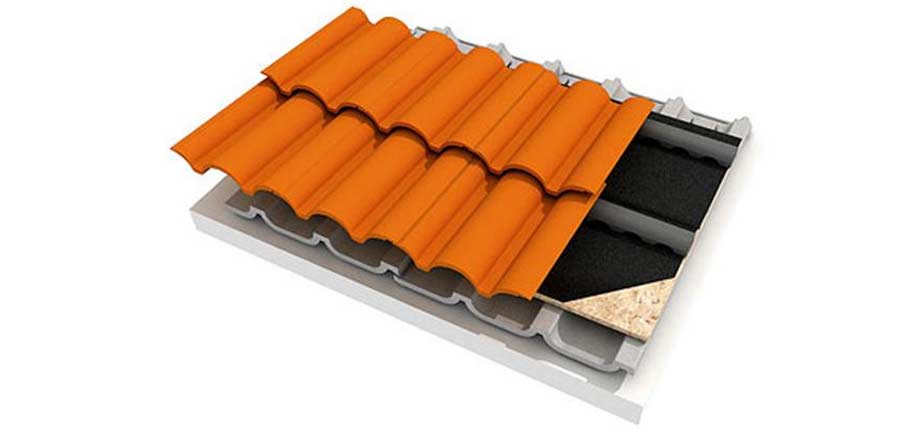
The new ventilated roofs incorporate a revolutionary mounting system, which forgets the attachment with paste to mount the tiles with nails and screws, and even staples. These are anchored to rails or plates that are mounted beforehand. And this creates an air layer to ventilate the space between the tiles and the interior ceiling.
This fastening system enables microventilation by allowing air to enter from the bottom of the roof, which exits from the upper side.
Advantages of ventilated roofs
[caption id="attachment_3316" align="alignnone" width="904"]
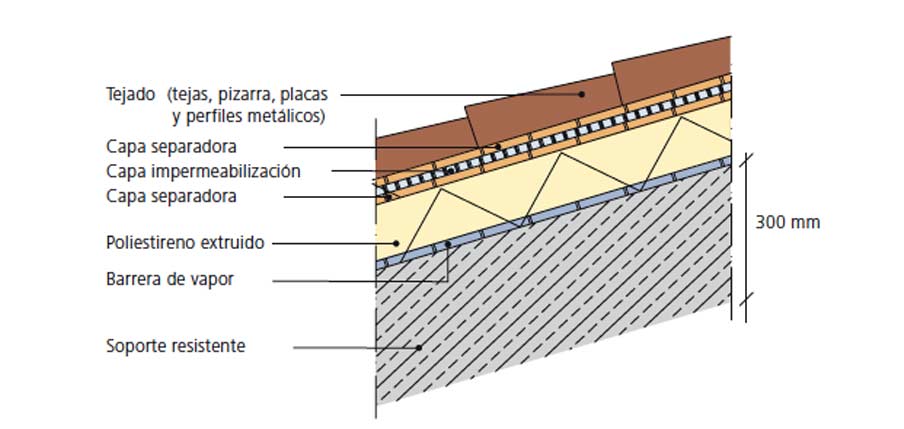 Diagram of a ventilated roof, photo from the Construmatica portal.[/caption]
The ventilated roof does not incur a much higher expense in its installation - on the contrary, it installs more quickly - and instead has evident improvements. Both in summer and in winter, there is a considerable increase in energy efficiency by preventing heat from escaping in the cold months and slowing down the rise in temperatures in the warm season.
During summer, the air stored between the tiles and the supports heats up and rises toward the air outlet, allowing outside air to enter. This helps ventilate the room better and increases comfort.
In winter, on the other hand, the air warms up between the tiles and the interior ceiling, helping to prevent the home’s heat from escaping. All of this translates to greater energy efficiency.
This microventilation process in ventilated roofs results in benefits such as:
- Temperature changes are somewhat less abrupt.
- In the summer months, the ventilated roof prevents the ceiling - in direct contact with the sun - from creating an oven effect in the rooms.
- The tiles dry out and moisture is prevented. Thus, no ice forms on the roof, nor mold or uncomfortable dampness.
- Ventilated roofs are more waterproof to rain or snow and last longer.
In any case, it is important to respect the standards when installing these roofs, as for the ventilation to be correct, the air must enter the covering and be able to exit without problems. The space between the tiles and the support must be, at a minimum, between 20 to 40 millimeters, depending on the tile. However, ideally, the larger the better. Ventilation gains in efficiency the larger this space is.
The materials for the supports that will hold the tiles can be made from various materials, from plastic or metal to wood. However, these materials and rails must be perfectly linear and of constant dimensions in height and width to allow uniform support for the tiles. It is important to create a uniform space.
The advancement of ventilated roofs is already a reality, and without a doubt, it is a very simple and cost-effective way to save on both electricity and gas bills, as it allows for better energy efficiency. This is because their installation helps reduce the use of heating and air conditioning systems in homes and other buildings.

Siber Ventilation
Related posts

Dehumidifiers and Other Systems to Improve the Health of Our Buildings