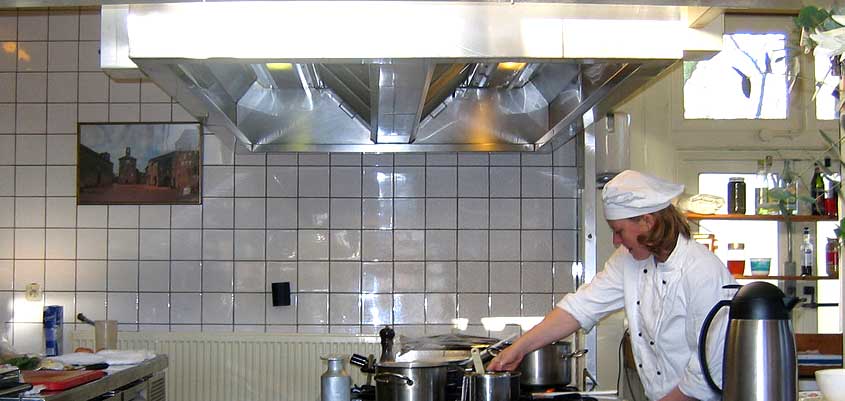
Industrial extractors hoods, regulations and uses for your business
The extraction of smoke in kitchens is essential to prevent health problems in our homes. However, in industrial environments, this need is even more important. In restaurants, fast food centers, and also in dining rooms where food is prepared for many people - and in front of the public - this requires a much stricter regulation. For everyone's safety, in industrial restaurant sectors, industrial extractors hoods that are suitable for the economic activity they are dedicated to must be chosen.
The industrial extractors hoods installed in places where food is cooked for a large audience must suck in the gases produced during frying or cooking. Many of these gases can be water vapor, although they can also include impurities and even particles from oil at high temperatures. It is essential that these industrial extractors prevent steam and smoke from spreading throughout the kitchen. Or, worse still, reaching the area where consumers are located.
As is logical, industrial extractors hoods are much larger than those installed in our homes. Their power must also be significantly higher. Considering that in some situations they are found in more closed spaces, they require high extraction capacities.
Their size will depend on the volume of air that needs to be extracted. This smoke extraction flow must be calculated precisely with the dimensions of the kitchen where it is located. The extraction surface must cover, at least, the entire cooking area.
There are different ways to calculate the flow of the industrial kitchen extractor hood, but all of them must be in line with what is specified regarding health standards in the Technical Building Code. For example, to calculate this flow, the following must be taken into account:
- Criteria of standard UNE 100165 for kitchen ventilation must be followed. This specification requires a minimum air flow velocity of at least 0.25 m/s through the open section between the hood and the burners.
The dimensions of industrial extractors hoods will depend on the location where they are installed.
A simple hood draws the smoke and vapors from inside the kitchen and releases it outside. They are dedicated solely to removing air, and do not utilize the energy contained in this air. Therefore, they tend to consume more energy, although they are the usual ones in the industrial sector.
With simple type hoods, the absence of odors and contaminants is guaranteed, although they may have some conflicts with the air conditioning system. When sucking in air, if it is summer and refrigeration equipment is used, the conditioned air will also be sent out of the rooms.
In cases of industrial applications, the use of recirculating extractor hoods is not recommended. In these models, it is possible that not all smoke or contaminated air is expelled. By regulation, these types of extractor hoods usually do not comply with industrial standards.
Regulations for industrial extractor hoods
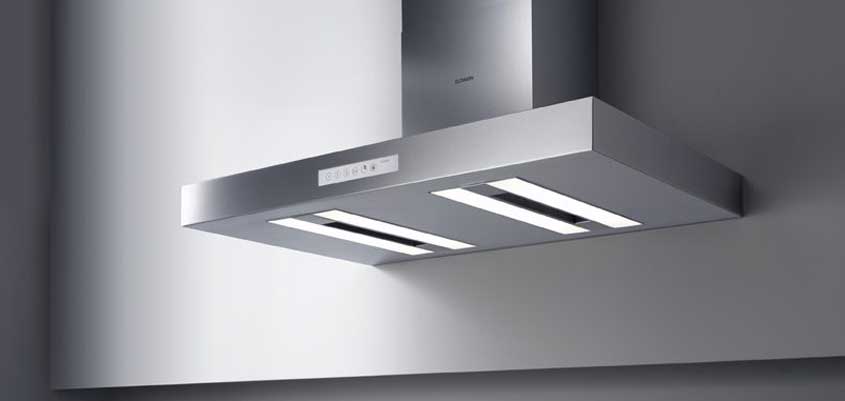
To comply with the regulations for industrial extractors hoods in Spain, it is necessary to consider what is explained in standard UNE 100-1-65-92. There, the minimum requirements for materials and also for the design of ducts are specified to ensure sanitary conditions. It also details maintenance, inspection, and cleaning needs. On the other hand, the following requirements are presented:
- Industrial extractors hoods must be 2 meters above the ground. It should be avoided that workers can bump into them.
- The edge must extend at least 0.15 meters on the sides.
- This type of industrial hoods must install metal filters for retaining grease and oils.
- These filters must have an inclination of between 45 and 60 degrees over the horizontal.
- Similarly, the air flow speed in these industrial extractors hoods must be between 0.8 and 1.2 meters per second.
- The filters must be placed 1.2 meters above open flames and more than half a meter from other heat sources.
- The general ventilation of the kitchen must be 10 liters per second per square meter.
- The kitchen must have a controlled temperature. The air introduced from outside into the cooking area must have a temperature ranging from a minimum of 14 degrees in winter to a maximum of 28 degrees in summer.

Siber Ventilation
Related posts